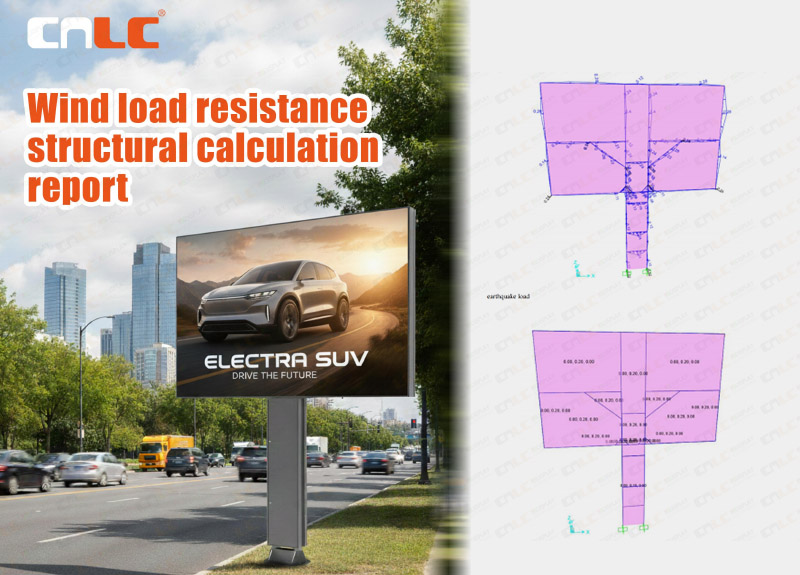
In the design of large-scale outdoor LED billboards, structural safety is always one of the most critical considerations. Due to their large display area and significant wind-exposed surface, wind load often becomes the decisive factor in whether a structural design succeeds or fails.
To ensure stable and safe operation in long-term outdoor environments, standardized wind load and structural calculations are an essential engineering verification, not a formal or symbolic process.
Why Do LED Billboards Have Higher Wind Load Requirements?
Compared with general outdoor display products, LED billboards typically have the following characteristics:
Large display area directly exposed to wind forces
Higher installation heights, resulting in significantly increased wind pressure
Long-term operation, usually running 24/7 continuously
Under strong wind conditions, wind load simultaneously acts on:
The LED display surface
The internal steel support structure
The aluminum profile frame system
Columns, base structures, and foundation connections
If the structural design is insufficient, even a normally functioning display may pose potential safety risks.
Composite Structural Design: Steel–Aluminum Collaboration for Structural Safety
Our outdoor LED billboards adopt a composite structural design that deeply integrates steel structures and aluminum profiles. These two materials are not arranged in a “primary–secondary” relationship; instead, each performs its specific role while working together to form a stable and reliable structural system:
Steel structures serve as the primary load-bearing framework, applied to columns, rear frames, and key supporting members. With their superior strength and stiffness, they resist the main wind-induced loads and form the structural safety foundation.
Aluminum profile structures are essential components of the display body, responsible for frame formation, module fixation, and load transfer. They ensure dimensional accuracy and structural consistency of the screen while optimizing overall weight through lightweight design. At the same time, wind loads acting on the display surface are evenly transferred to the steel structure, forming a complete “load reception – transmission – bearing” force path.
This composite structural solution achieves an optimal balance among strength, stiffness, durability, and overall stability, making it well suited for demanding outdoor wind environments.
Wind Load Structural Calculations Based on Design Codes
All structural calculations are conducted in accordance with Code for Design of Building Structures Loads (GB 50009-2012) and referenced against Code for Seismic Design of Buildings (GB 50011-2010). Conservative engineering parameters are applied throughout the analysis to ensure the reliability and safety of the calculation results.
Key Design Parameters (Example)
Display area: 12 m²
Installation height: 10 m (structural calculation height z = 10 m)
Basic wind pressure: 0.27 kPa
Adjusted design wind pressure (standard wind load value): 0.36 kPa
Load Combination and Unfavorable Condition Verification
To simulate the most unfavorable operating conditions, the following load combination is adopted:
1.3D + 1.5W + 0.7E (D = Dead load, W = Wind load, E = Seismic load)
Under this condition:
Maximum load perpendicular to the display surface: 3.97 kPa
Structural Deformation Verification
Maximum structural deformation: 40.3 mm
Code-allowed deformation limit: 46 mm
The results show that structural deformation is strictly controlled within allowable limits, effectively preventing issues such as module loosening or display abnormalities caused by excessive deformation, thereby ensuring long-term operational stability.
Structural Strength Verification
Steel Structure
Material: Q235B structural steel
Maximum calculated stress of key steel members: ≈ 200 MPa (lower than the steel design strength of 215 MPa)
The results fully comply with code requirements, confirming reliable structural strength.
Aluminum Profile Structure
As a core component responsible for load transfer and structural formation, the aluminum profile system undergoes rigorous multi-dimensional verification:
Collaborative load-sharing design with steel structures, ensuring uniform wind load distribution and avoiding local stress concentration
Independent strength verification at critical load points such as module connections and corner supports
Synchronized deformation control, ensuring consistent deformation behavior between aluminum and steel structures
Connection stability verification, including pull-out and shear checks for aluminum–steel and aluminum–module connections
These validations ensure that aluminum profiles not only provide lightweight and precise structural formation but also maintain sufficient safety margins within the overall structural system.
Complete Structural Verification from Display to Foundation
The calculation scope covers all critical structural elements, achieving comprehensive safety verification from the display body to the foundation:
Load analysis of columns and base structures
Tensile and shear verification of anchor bolts
Verification of anchorage length and foundation bearing capacity
This full-chain validation ensures structural stability even under extreme wind and seismic conditions.
Applicable to the Entire Range of Outdoor Display Products
Although this article uses an outdoor LED billboard as an example, the same structural design principles and wind load calculation methodology apply to a full range of outdoor display products, including:
Outdoor LED Billboards
Outdoor LED Totems
Outdoor LED Mupi Displays
Outdoor LCD Digital Signage Totems
Drive-Thru Digital Menu Boards
Smart City Display Systems
Corresponding wind load calculation reports and structural documentation can be provided based on specific project requirements.
Engineering Validation for Long-Term Reliable Operation
In actual engineering implementation, we have completed multiple code-compliant wind load and structural calculations for various outdoor display structures, including outdoor LED billboards and outdoor LCD totems / digital signage systems. This accumulated engineering experience has been standardized and applied across different product platforms to guide structural design and safety verification, ensuring long-term reliability under diverse installation conditions.
Wind load structural calculation is not a formality—it is a real engineering validation of safety, stability, and long-term durability. Whether through the core load-bearing role of steel structures or the collaborative contribution of aluminum profiles, all designs adhere to a “safety-first” principle, making structural stability a fundamental standard across all our outdoor display solutions.
Data Source Disclaimer
The structural parameters and calculation results referenced in this article are derived from actual project wind load and structural calculation reports. Specific values may vary depending on product dimensions, installation methods, project location (such as terrain roughness and basic wind pressure), and applicable design codes. Final results shall be subject to project-specific engineering calculation documents.